Indoor wood can be protected and enhanced with lacquers or oils. But which system is suitable for which surface? Here you will learn how lacquer and wood oil differ, how both systems work and what to consider during application and care.
In short: Lacquer forms a closed protective layer on the wood. Oil penetrates the pores, protects from within and preserves the natural feel.
Lacquer: protection on the surface
Durable surface film, various gloss levels and easy cleaning - but more laborious to renovate when damaged.
Oil: protection from within the wood
Open-pore protection with a natural look and feel, low consumption and partial repairability - but requiring regular renewal.
Lacquers: durable protective layer on the wood

- form a durable protective layer on the wood
- allow surfaces ranging from matte to glossy
- restrict diffusion and breathability through the lacquer film
- are suitable for dimensionally stable components
- often require a primer on resinous and exotic woods
- are generally not repairable in sections
- Coverage: approximately 100–120 g/m² per coat
- Coats: usually two to three, depending on the system and level of wear
After drying, lacquers form a durable surface film. Depending on the product, the surface may be glossy, satin-matte or matte. The film seals the wood and provides a mechanical protective layer with comparatively high durability. At the same time, it restricts the breathability of the wood.
If the lacquer layer is damaged, the underlying wood may become exposed. Water penetrating through scratches can cause unsightly gray discoloration. For professional renovation, the lacquer surface therefore often has to be completely sanded down and rebuilt.
Lacquers are available as clear or color lacquer and in water- or solvent-based formulations. Water-based lacquers generally have a lower VOC content. Lacquers are also categorized by application method and area of use, for example as parquet, spray or dip lacquer.
A lacquer system is generally more complex than an oil treatment. Depending on the system and application area, two to three coats of approximately 100–120 g/m² each are required. The lacquer can be brushed, rolled, or sprayed.
Lacquered surfaces are easy to clean: Regular dusting and wiping with a barely damp cloth are usually sufficient. For sealed wooden floors, a suitable parquet polish can occasionally be applied to maintain the protective film.
Oils: open-pore protection from within

- penetrate the wood and protect it from within
- remain diffusion-open, moisture-regulating, and breathable
- offer good resistance to dirt and liquids
- are also suitable for non-dimensionally stable components, as they do not crack or flake off
- can be used on almost all types of wood
- emphasize color and grain while preserving the natural feel
- are easy to renovate partially
- Coverage: approximately 20–40 g/m² per coat, depending on the system
- Coats: usually one to two, depending on the oil and absorbency
- require regular refreshing
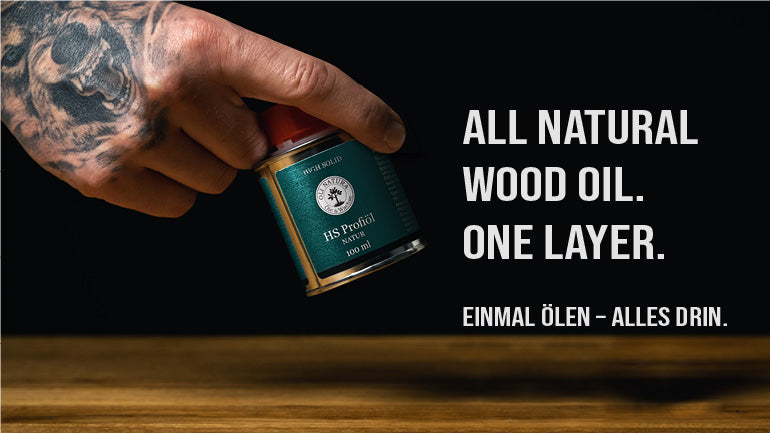
Natural oil-based oils do not form a continuous film. They impregnate the wood open-pore, penetrate the pores, and protect it from within. The wood remains breathable and can release absorbed moisture back into the air. Oiled surfaces usually have a low gloss level and pronounced color enhancement.
Because the protection lies within the wood, minor damage does not immediately expose large areas of unprotected wood. Dents and scratches can often be sanded locally and re-oiled without having to refinish the entire surface.
In addition to unpigmented oils, there are color oils. Unpigmented variants emphasize the wood’s natural color and grain; how strongly the wood is enhanced also depends on the type of wood. Oils also differ in their solids content. High-solid oils, or HS oils for short, have a particularly high solids content.
Wood oils are versatile and easy to apply. At approximately 20–40 g/m² per application, they are highly economical. Depending on the type of oil and the absorbency of the wood, one or two applications are often sufficient for good resistance to dirt and liquids.
Oiled surfaces have an antistatic effect. A dry or slightly damp cloth is usually sufficient for cleaning. Floors can be cleaned regularly with a mop, vacuum cleaner or soft-bristle broom. To maintain the protective effect over the long term, the surface should be refreshed as needed with a suitable maintenance oil.
Lacquer or oil in direct comparison
| Criterion | lacquer | Oil |
|---|---|---|
| Protection principle | sealed film on the surface | open-pored impregnation in the wood |
| Appearance | from matt to glossy | natural, usually matt and enhancing the wood grain |
| Feel | wood structure is less directly perceptible | natural wood structure remains perceptible |
| Renovation | usually requires complete resurfacing | can often be partially sanded and recoated |
| Maintenance | easy to clean, little ongoing maintenance | easy to clean, regular refreshing recommended |
| Consumption | approx. 100–120 g/m² per application | approx. 20–40 g/m² per application |